A heat pump does not "produce" heat — it moves it from the cold environment (air, ground or water) into your home, using several times less electricity than the heat it delivers. That is why it is one of the most efficient ways to heat a home. Let's look at how it works — from the theory to the modern technologies Termojet uses in its heat pumps.
The theory: the reverse Carnot cycle
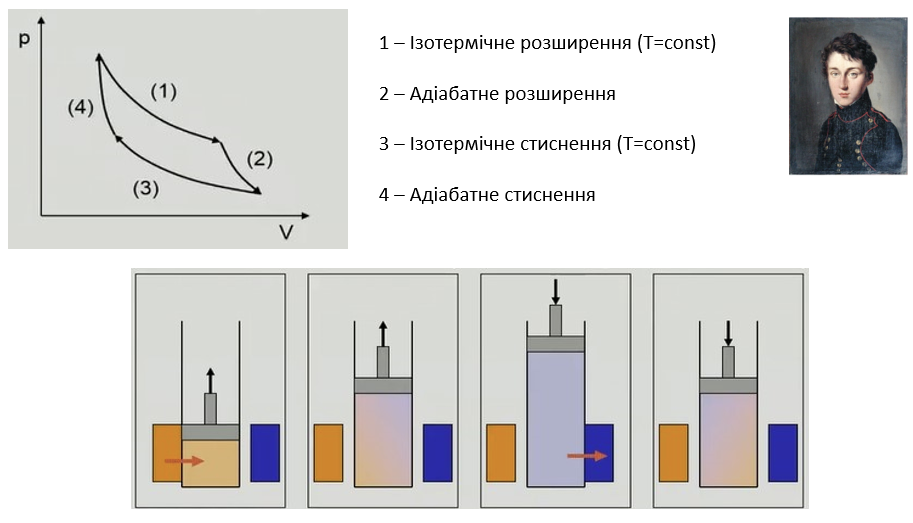
A heat pump is based on the reverse thermodynamic Carnot cycle. It defines the maximum possible efficiency of transferring heat by doing external work, using the temperature difference between a low-grade heat source and the heated space.
The cycle is named after the French physicist and engineer Sadi Carnot, regarded as the father of modern thermodynamics. He laid the foundations of the science in 1824, describing how heat engines work in his only publication, "Reflections on the Motive Power of Fire and on Machines Fitted to Develop That Power".
The principle requires two things:
- A working fluid (refrigerant) with the right properties;
- Equipment that carries out 4 working stages.
Key properties of the working fluid (refrigerant):
- It boils below the temperature of the environment / home;
- It exists in both liquid and gaseous states;
- When it evaporates, it absorbs heat;
- When it condenses, it releases heat.
How the equipment works in heating mode (reverse cycle):
- Stage one: the refrigerant absorbs heat from outside;
- Stage two: work is done to compress the refrigerant;
- Stage three: the refrigerant releases heat (into the home);
- Stage four: work is done as the refrigerant expands.
A key advantage: the cycle is reversible. Run it in the forward direction and the same unit works in cooling mode — so a heat pump can both heat in winter and cool in summer.
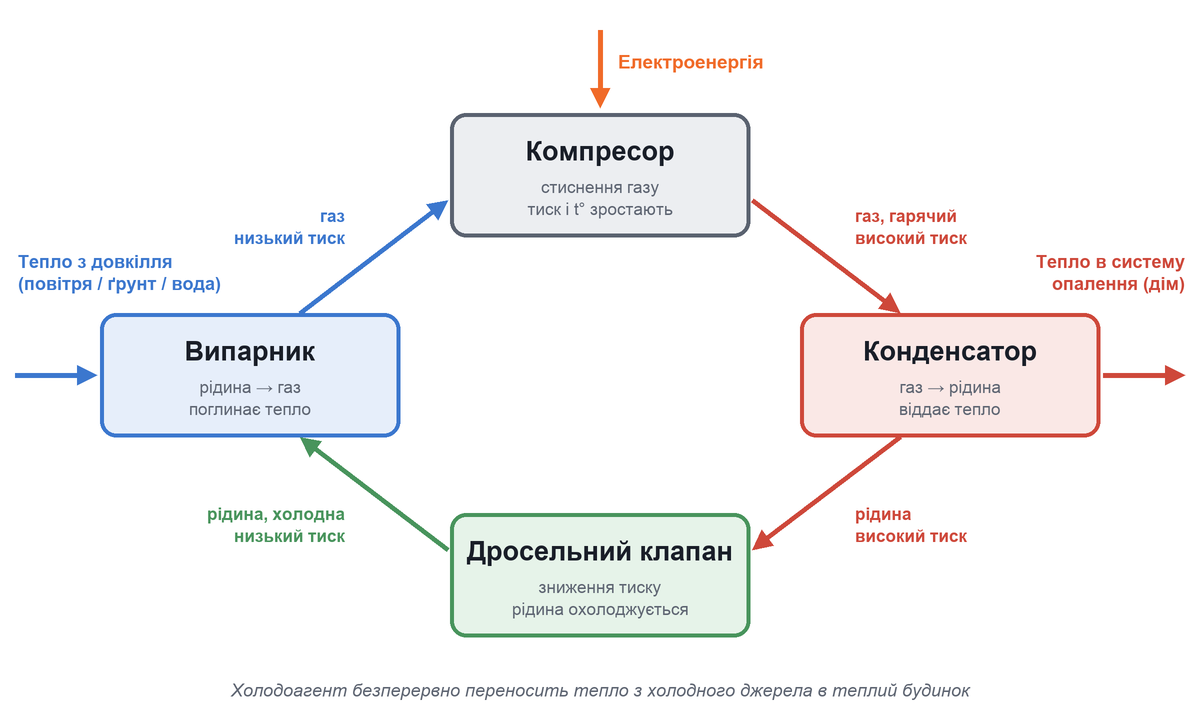
How a heat pump works: 4 key components
In detail, a heat pump relies on the laws of thermodynamics and on the refrigerant constantly changing from liquid to gas and back. Four main components make this happen.
Evaporator
Functions: absorbs heat from outside; turns the refrigerant from liquid into gas.
With its low boiling point, the refrigerant turns from liquid into gas as it takes in heat from outdoor air, groundwater or the ground.
Compressor
Functions: compresses the refrigerant from low to high pressure; maintains the pressure difference and drives the refrigerant flow.
The gaseous refrigerant enters the compressor, which runs on electricity. The compressor squeezes the gas, so its pressure and temperature rise sharply.
Condenser
Functions: transfers heat into the heating system according to the heat load; turns the refrigerant from vapour back into liquid.
The hot high-pressure gas passes through the condenser (heat exchanger). Here it gives its heat to the home's heating system — radiators, underfloor heating or water — cools down and becomes liquid again.
Throttle valve (electronic expansion valve)
Functions: lowers the refrigerant pressure from high to low; maintains the pressure difference between the high and low sides.
The liquid refrigerant passes through the valve, its pressure drops and the liquid becomes very cold. The cycle closes — and starts again.
Modern technologies in Termojet heat pumps
The classic cycle above is the foundation. Real-world efficiency and the ability to cope with a Ukrainian winter depend on technology. Termojet heat pumps use the following:
EVI (Enhanced Vapor Injection)
EVI injects refrigerant vapour into the compressor, giving it an extra boost and keeping its output up even in hard frost. Thanks to EVI, a Termojet heat pump runs stably and efficiently down to −25 °C — critical for the Ukrainian climate, where ordinary models lose capacity sharply.
Inverter control (DC Inverter)
An inverter compressor smoothly adjusts its output to what the house actually needs instead of switching on and off. This cuts electricity use significantly, removes start-up overloads and extends equipment life.
Energy efficiency and refrigerant
- A+++ energy class and a coefficient of performance (COP) of up to 5.1 (up to 3.68 at A7/W35) — for every 1 kW of electricity the pump delivers several times more heat.
- Modern refrigerants (R32 / R410a) with high heat output.
- A range from residential to industrial systems (EVI-U series, ~10 to 188 kW), with cascade connection and a built-in inverter pump.
Choose a heat pump for your home in the Termojet catalogue.
Heat pump piping: the role of Termojet equipment
For a heat pump to work efficiently and last, proper hydraulic piping matters. Termojet manufactures a full set of assemblies for heat pump boiler rooms:
- Hydraulic separator (low-loss header) — decouples the heat pump circuit from the consumer circuits and keeps the flow through the heat exchanger stable.
- Pump groups — ready-made units for radiator and underfloor circuits with precise temperature control.
- Distribution manifolds and underfloor heating manifolds — distribute low-temperature heating water across circuits.
- Air and dirt separators — protect the heat pump's heat exchangers from dirt and air locks.
- Circulation pumps — energy-saving pumps for heating circuits.
Conclusion
A heat pump is a modern, economical and eco-friendly way to heat your home: it moves free environmental heat indoors, and thanks to EVI and inverter control it works efficiently even in frost.
Not sure which model suits you? Read how to choose a heat pump for your home or contact us — we will select the heat pump and piping for your project.